

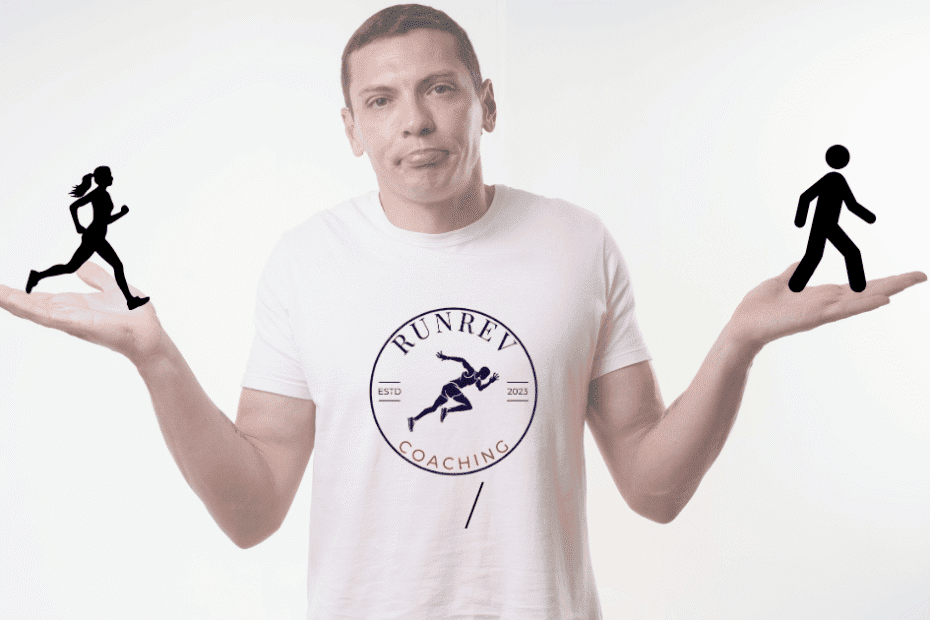
My last post was about the need of community as a runner. Today, I’m looking at what makes you a runner. Am I a runner if I walk? Yes.
Some people won’t call themselves runners. I get it, because I was one of them, at least for a while.
I started running in 2012 with no big plan. I could run, and I was slow. I had no problem calling myself a runner. Even as the back-of-the-pack person, I was a runner. What I never called myself was an athlete.
That’s a different word in my head. For a long time, an athlete was the person on the podium. The one who finished first, second, or third. The slender one with no extra body fat, running 15- and 16-minute 5Ks, or a 2:30 marathon. That wasn’t me, so I didn’t claim it.
About four years ago, I had a revelation. I was putting training plans in my calendar and following them pretty religiously. I knew my paces. I planned my gels, my long runs, and my routes. I analyzed my data. I was looking at what I ate and trying to improve it. I was timing myself. If that isn’t being an athlete, I don’t know what is.
The Pace Myth
You’ve probably seen people online say you have to run a certain pace to be a real runner. If you’re slower, you’re ‘just a jogger’ or ‘just a walker.’
That’s a lie.
If you run, you’re a runner. If you run and take walk breaks, you’re a runner. It doesn’t matter if you run at a 5-minute mile or a 16-minute mile. It doesn’t matter if you’re run-walking one minute and walking five.
The act of running is having both feet off the ground at some point in your stride. That’s the mechanical action. Pace has nothing to do with it.
I’ll say this too. If you’re walking, that’s great. I’m not shaming anyone who walks. Walkers still cover the miles, and they often spend much longer out in the sun, or the cold, than faster runners do. That’s a real challenge. Don’t look at a walker and call them “just” anything.
Why This Matters
When people tell you that you’re not a real runner, they want you to feel small. Comparison makes some people feel better about themselves, but you’re not here to compare yourself to them. You’re here to compare yourself to who you were last week.
Being wronged is real, too. Many of us have been made to feel less than in a race or a group. You have every right to be upset about that. But if you stay there, the hurt starts to define you. Then people don’t want to be around you. I know this from experience. After I lost my mom, I was short-tempered and useless. It took an ultimatum from my wife to get me out of that. I don’t want you to waste time wishing you’d moved sooner. You can move from where you are today.
Stronger Than the Struggle
Strength is not about never falling. We all fall. I’ve tripped on sidewalk cracks and a flat bike path. Once I tripped so many times I rolled, stood up, and kept going. I’m proud of that, not because I fell, but because the fall didn’t define me.
I’m not talking about pushing through an injury. If something is broken or seriously hurt, stop. But when you get a scrape and you know you can keep going, and you choose to, that’s strength.
It’s also okay to feel sad, hurt, or angry about how things went. Feelings aren’t the problem. The problem is staying down. As long as you keep getting back up, even slowly, you’re still in the fight.
Choices, Not Labels
Your identity isn’t set by your worst day or your worst habit. It’s shaped by the positive choices you make each day.
If you add five minutes of walking today, you’re a walker. If you run one day a month, you’re a runner. If you swap an orange for a candy bar, that’s a good choice. If you eat the candy bar and adjust the rest of your day, that’s a good choice too.
Ask whether a choice moves you toward a better version of yourself. That’s what makes you strong.
If You Need Help
Sometimes getting up takes help. I figured a lot out online when I started, and I could have learned faster with someone in my corner. That’s why I offer strategy calls. It’s a one-time 60-minute session to build a plan if you’re starting out, or to look at what’s working if you’ve been at this for years. You can book your strategy call here. If you are unsure of where to start, a free discovery call is a great place to start.
I talk through this in Episode 6 of Stronger Than the Struggle. You can listen to Episode 6 on Spotify or browse all the episodes on the podcast page.
I coach runners in Dayton, Cincinnati, and online.
You don’t have to earn the title runner. If you’re moving forward, you already are one.